
Memory-Based Emotion Recognition Using Wearable EEG and Deep Learning
- Status
- Current
- Research area
- Rehabilitation
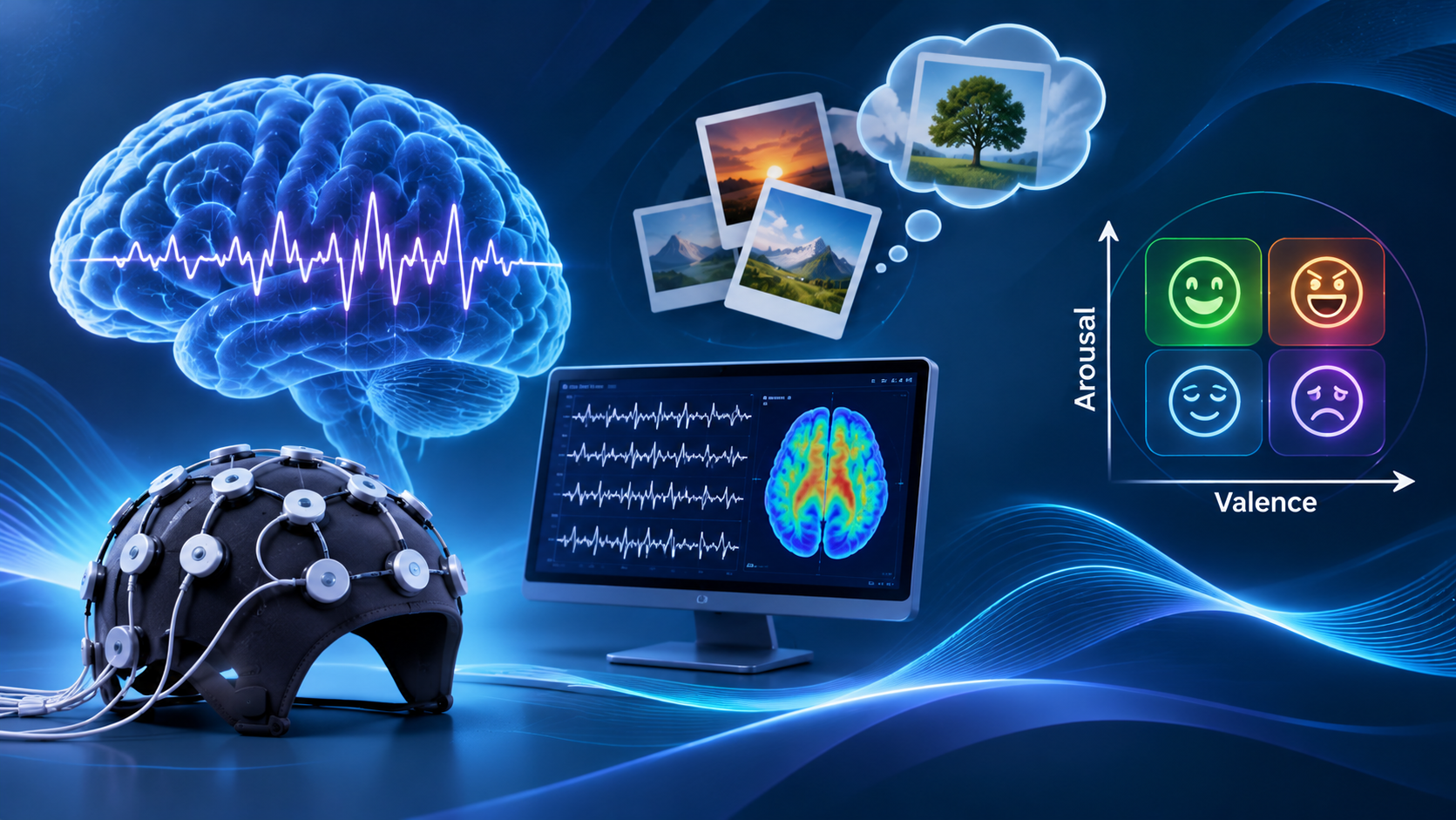
Human emotions are closely associated with personal experiences, memories, and individual responses to everyday situations. However, most existing automatic emotion-recognition systems rely on externally presented stimuli, such as images, videos, and sounds, to evoke emotional responses. Although these approaches provide controlled environments for studying emotions, they do not fully capture how emotional states naturally emerge through the recollection of personal experiences. In everyday life, individuals may experience a wide range of emotional responses simply by recalling significant autobiographical memories. Recognizing these memory-induced emotional states presents an important challenge, as emotional experiences are subjective and reflected in complex patterns of neural activity. This research explores the use of wearable electroencephalography (EEG) to investigate emotional responses during autobiographical memory recall, providing an alternative approach to emotion recognition beyond conventional stimulus-based methods.
This research develops a deep learning framework for recognizing memory-induced emotional states from EEG signals collected during autobiographical memory recall. A wearable EEG cap was used to acquire brain activity from 69 participants, while affective words were presented to trigger personal emotional memories. Participants self-annotated their emotional experiences using valence and arousal dimensions, allowing the responses to be categorized into four emotional states: high-valence/high-arousal, high-valence/low-arousal, low-valence/high-arousal, and low-valence/low-arousal. The recorded EEG signals undergo preprocessing to remove noise, artifacts, and baseline activity, followed by the extraction of different EEG rhythms to characterize neural responses. A deep learning framework is subsequently employed to learn temporal patterns from the processed signals and distinguish between the four emotional categories. By investigating emotional responses generated through personal memory rather than relying exclusively on externally presented stimuli, this work aims to advance EEG-based emotion recognition in more natural and personalized settings.
