
EKKO: An AI-Enabled Neurostimulation and Cognitive Rehabilitation Ecosystem
- Status
- Completed
- Research area
- Rehabilitation
On this page
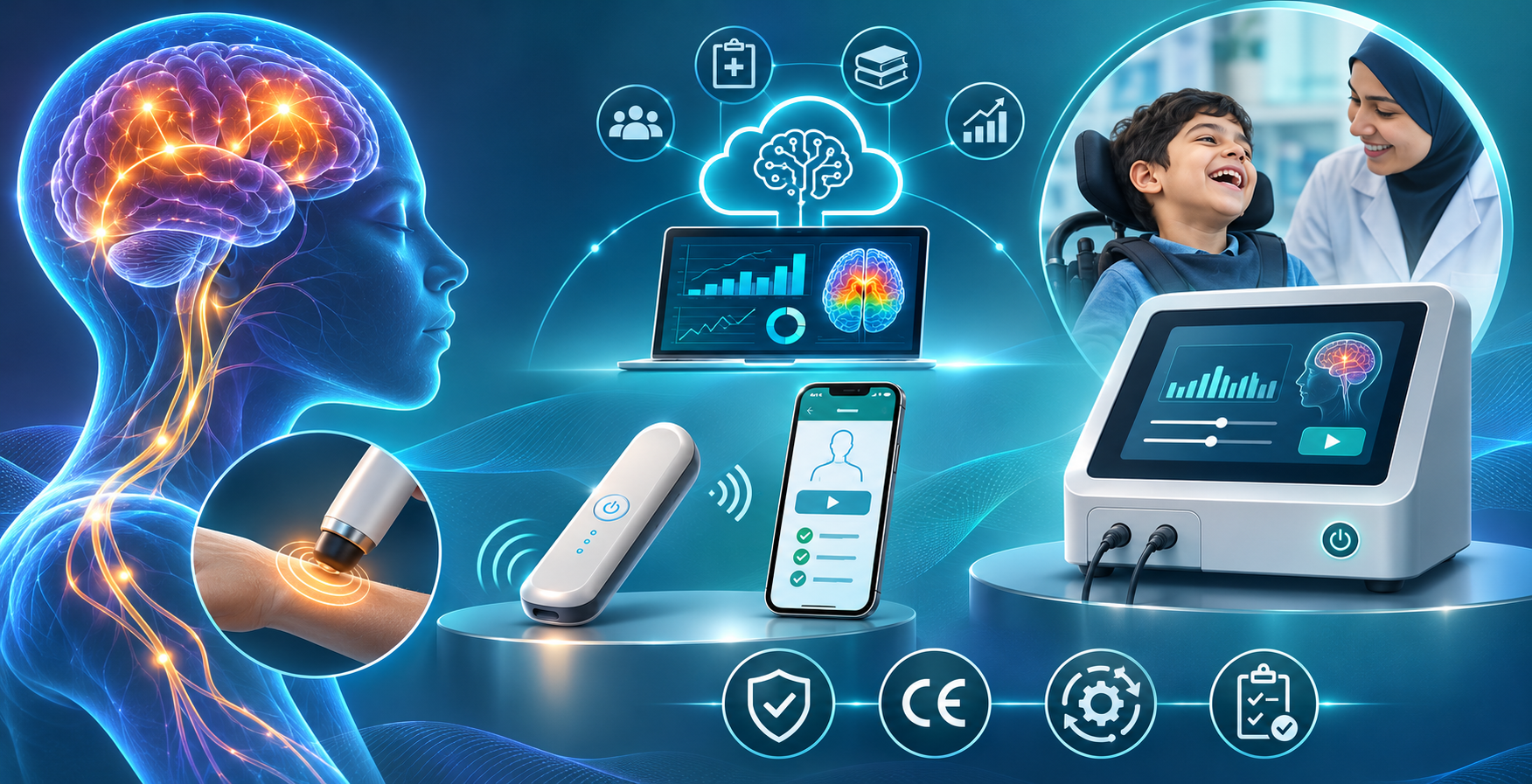
EKKO is a portable vibrational therapy device and software system designed for early-stage cognitive rehabilitation in children with speech and movement disorders. Guided by Neurotransmission Cognitive Theory, it applies mechanical vibrations to reactivate neural pathways in viable, shock-affected brain cells for convenient use at home or in special education centers.
Grounded in the proposed Neurotransmission Cognitive Theory, our work introduces a non-invasive cognitive rehabilitation method that applies targeted mechanical vibrations to peripheral nerve points to stimulate and reactivate dormant brain regions, showing promising outcomes in a pilot study involving 3 patients with dysarthria and cerebral palsy. To translate this theory into clinical and home care, we engineered a dual-module ecosystem pairing customizable vibration hardware with an AI-based assistant that aggregates clinical outcomes, literature, and user feedback into a unified knowledge base for trend analysis and decision support. For home-based care, we developed EKKO Portable, a compact 5 × 20 × 3.8 cm handheld unit powered by a 3500 mAh battery that delivers vibrations across a 12–95 Hz frequency range and connects via Bluetooth Low Energy to a companion mobile app offering step-by-step, patient-specific guidance and cloud data logging. For clinical environments, we built EKKO Clinic, a mains-powered system on a single-board computer platform featuring a 7-inch capacitive touchscreen and an expanded 5–100 Hz therapeutic frequency range.
To ensure medical-grade safety and regulatory compliance across both platforms, EKKO Portable was rigorously tested against the international EN 60601-1 medical electrical safety standard and approved by the Pakistan Innovation & Testing Centre, while EKKO Clinic was constructed using CE-certified components. Furthermore, we introduced the Enhanced Agile V-Model, a hybrid systems-engineering methodology that merges agile flexibility with plan-driven rigor to unify hardware and software development under strict medical regulations. Mapped directly to the MDEVSPICE framework, this process demonstrated full compliance with the IEC 62304 standard and yielded statistically significant improvements (p < 0.05) in usability, efficiency, and safety during the development and validation of our wave therapeutic devices.

Relevant Publications
- Khan, Aliya Ashraf, Muhammad Usman Akram, Shahbaz Khalid Ranjha, and Madeeha Nissar. "Pilot study of neurotransmission cognitive therapy using ultra-low-frequency vibration waves in children with cerebral palsy–associated spastic dysarthria." Developmental Neurorehabilitation (2026): 1-12.