
NeuroFusion: An Intelligent AI Framework for Structured Brain Tumour MRI Reporting
- Status
- Completed
- Research area
- Radiology
Brain MRI plays an important role in the detection, diagnosis, and characterization of brain tumours, providing detailed information about tumour location, structure, and extent. However, interpreting complex MRI scans and preparing accurate, comprehensive radiology reports can be time-consuming and demanding for radiologists, particularly with increasing imaging workloads and limited availability of specialized diagnostic expertise. Although recent advances in medical artificial intelligence and vision-language models have enabled automated interpretation of medical images and report generation, existing approaches may produce incomplete descriptions, incorrect tumour diagnoses, or misleading clinical information. A major challenge is ensuring that the diagnostic findings identified through image analysis are accurately communicated in the generated reports. This highlights the need for intelligent reporting systems that combine reliable image analysis, structured diagnostic information, and medical language generation to support accurate and efficient radiological reporting.
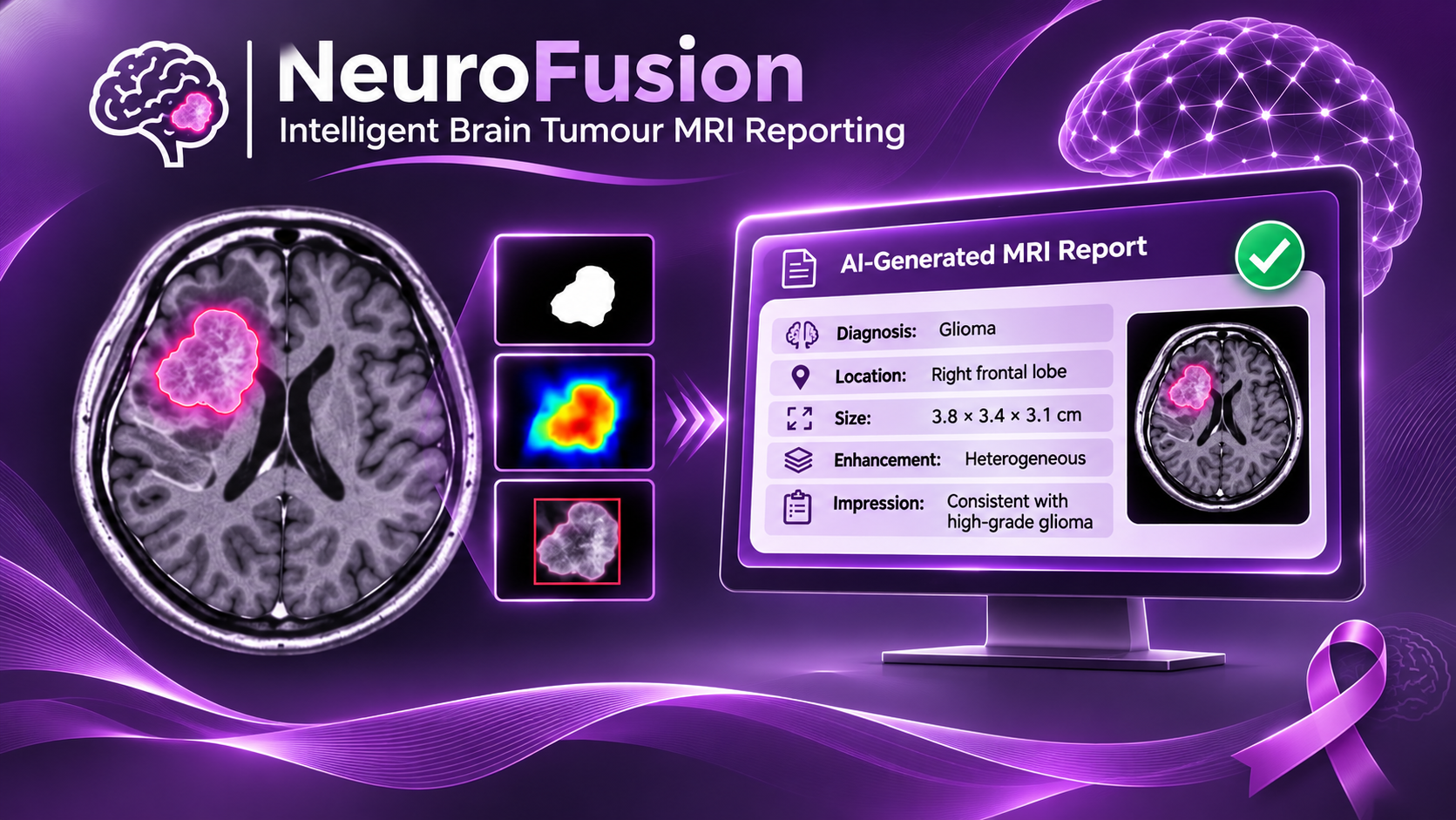
This research introduces NeuroFusion, an AI-assisted framework for generating structured and diagnostically informative brain tumour MRI reports. The proposed approach integrates a frozen MedNeXt-L segmentation backbone for tumour localization and segmentation, followed by connected-component-based lesion routing to identify individual tumour regions. A Q-Former is employed to extract lesion-specific visual features, which are subsequently processed through dedicated discriminative field-classifier heads to predict structured tumour characteristics. These predictions are used to guide a QLoRA-fine-tuned medical Mistral-7B language model in generating comprehensive reports through a single-pass draft-and-review process. Furthermore, grammar-constrained decoding using XGrammar ensures that the generated reports conform to a predefined JSON schema, enabling structured and verifiable outputs. Evaluation across glioma, meningioma, and metastasis cohorts demonstrated that NeuroFusion outperformed a same-backbone chain-of-thought reporting model in 8 out of 9 comparisons while reducing report-generation latency by approximately 5–6 times. A blinded pilot evaluation involving two board-certified neurologists also demonstrated promising clinical performance, with the framework receiving the highest ratings across all three tumour types and recording zero critical errors across nine evaluated cases.
