Knowledge-Distilled Transformer Framework for Automated Spine CT Report Generation
- Status
- Completed
- Research area
- Radiology
Spine computed tomography (CT) plays an important role in the diagnosis and assessment of spinal conditions, including fractures, tumours, and degenerative abnormalities. However, interpreting spinal CT images and preparing detailed radiology reports require considerable time and specialized expertise. Manual reporting can also introduce variations in terminology, reporting styles, and descriptions of spinal findings, making consistency a significant challenge. These limitations highlight the need for automated reporting approaches that can bridge the gap between medical image analysis and clinical text generation. This research explores transformer-based deep learning techniques and knowledge distillation to develop an automated framework capable of translating spinal CT images into meaningful radiological descriptions.
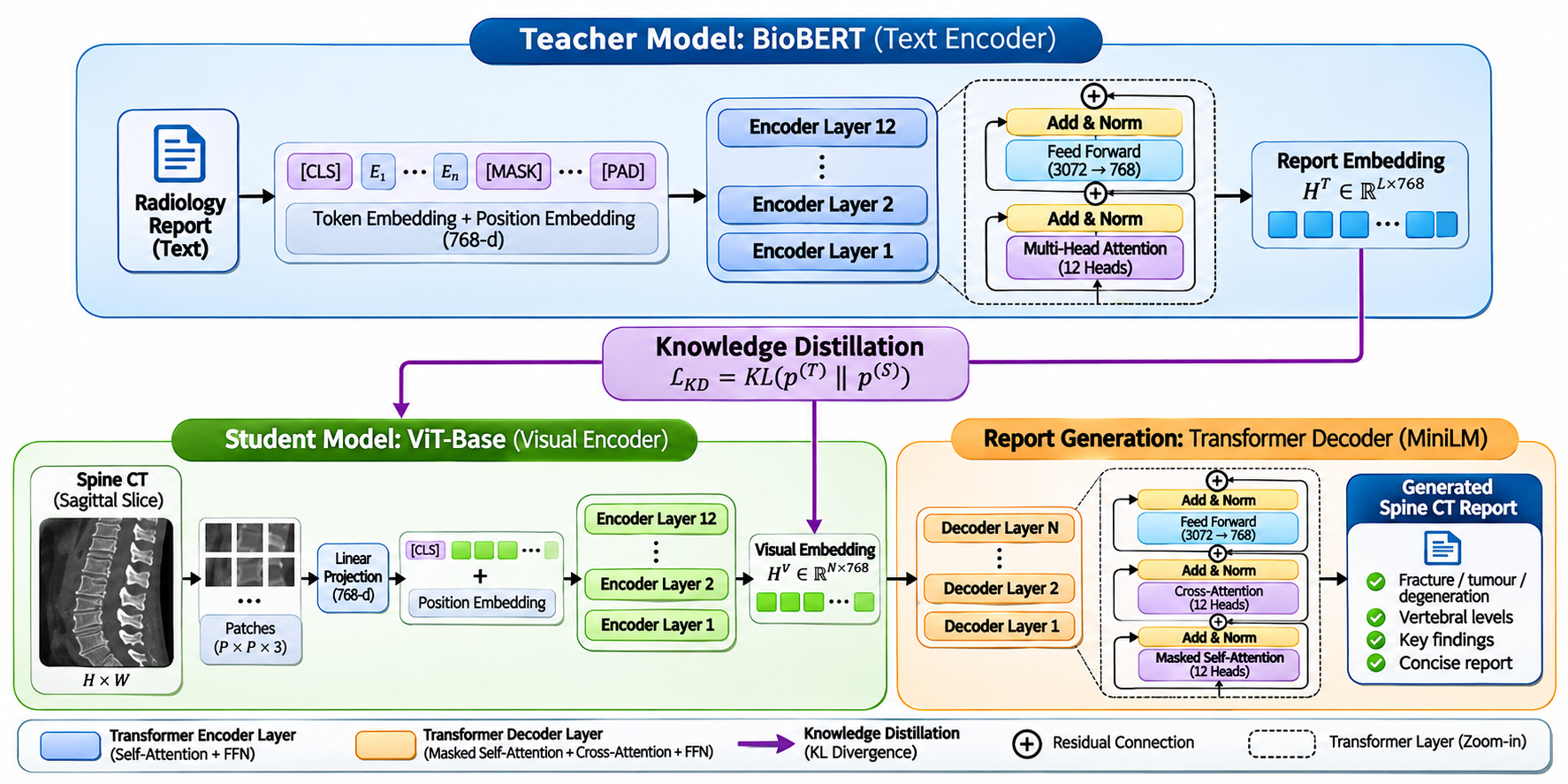
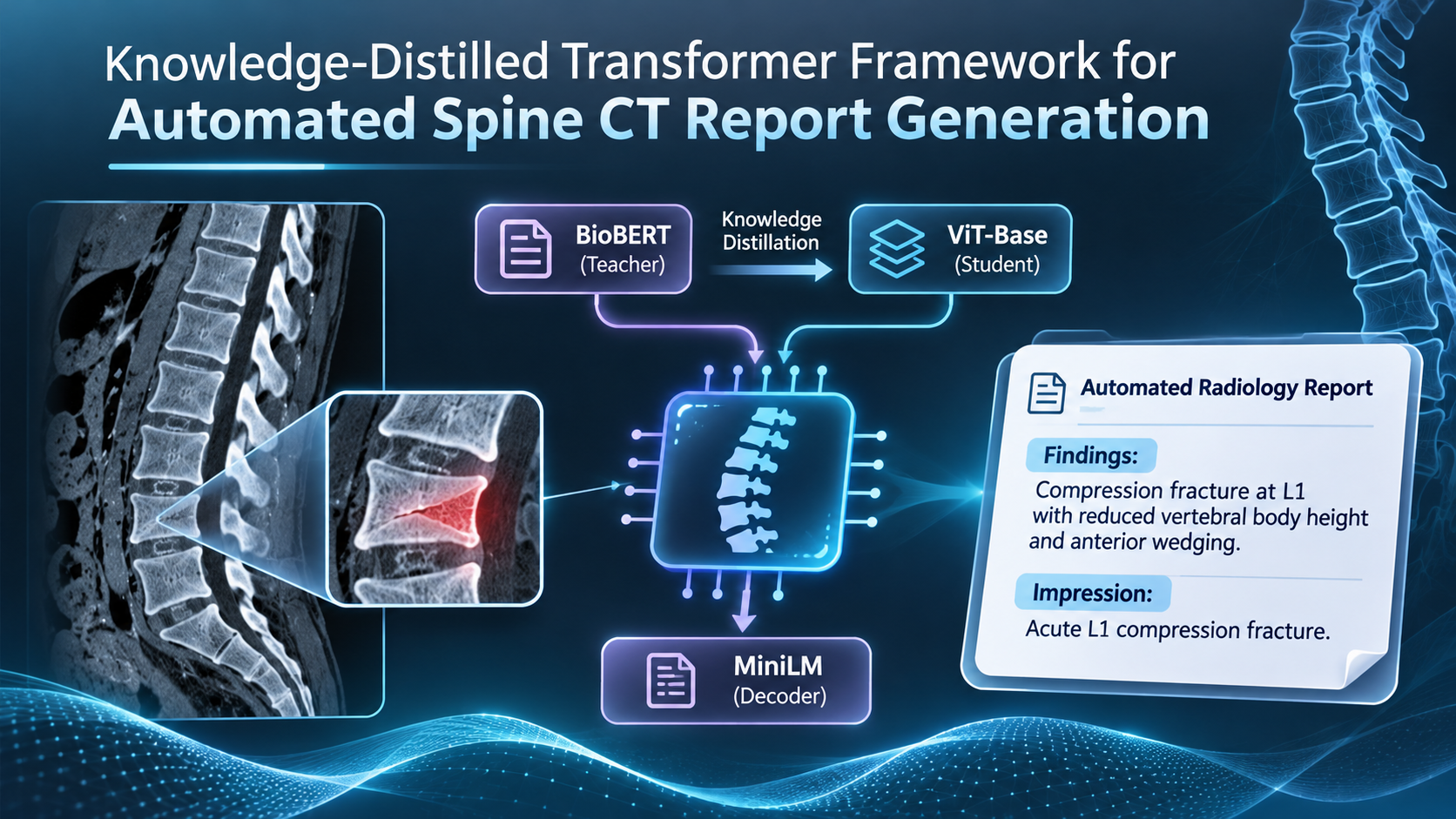
This research proposes a knowledge distillation-based transformer framework for generating radiology reports from sagittal spine CT images. The proposed approach employs BioBERT as a teacher model and Vision Transformer (ViT-Base) as a student model to transfer domain-specific textual knowledge into the visual encoder through knowledge distillation. The distilled ViT is subsequently integrated into an encoder–decoder architecture, with MiniLM serving as the decoder to generate textual descriptions of spinal findings. The framework was evaluated using 300 sagittal CT images from the publicly available VerSe20 dataset, accompanied by radiologist-prepared reports. Different reporting configurations were also investigated, including original reports, reports without vertebral-level annotations, rephrased reports, and ChatGPT-generated reports. Experimental results demonstrated improvements in report-generation performance through knowledge distillation, increasing BLEU-1 from 0.6361 to 0.7291 and BERT score from 0.7486 to 0.7522. The findings further highlighted the impact of vertebral-level annotations on text-generation performance, with their removal improving most evaluation metrics. This work aims to advance automated radiology reporting through the integration of domain-specific knowledge and transformer-based visual and language representations.