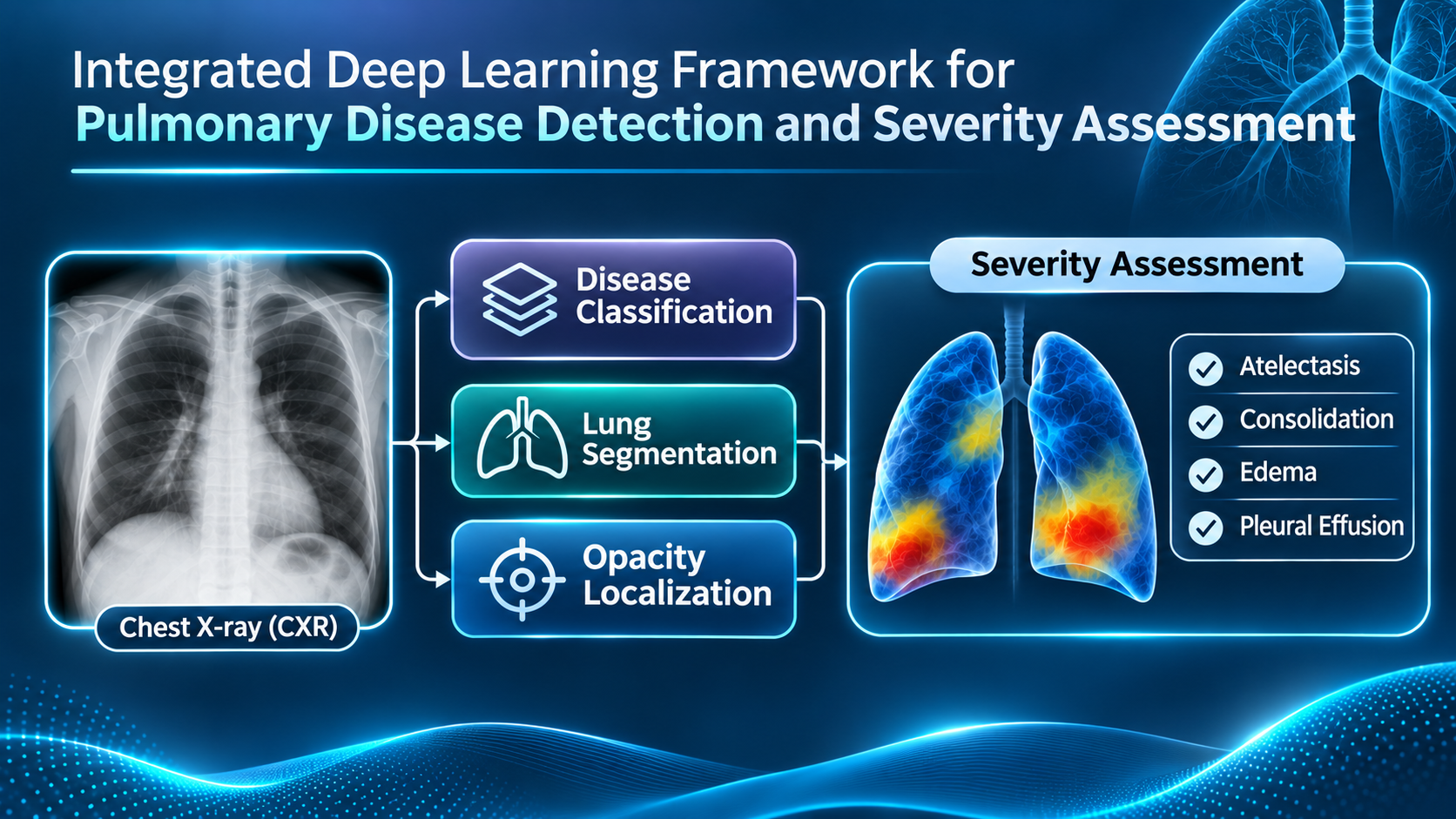
Integrated Deep Learning Framework for Pulmonary Disease Detection and Severity Assessment
- Status
- Completed
- Research area
- Radiology
Chest X-rays (CXRs) are among the most widely used imaging modalities for pulmonary disease assessment due to their accessibility, affordability, and clinical importance. However, accurately identifying multiple pulmonary conditions, localizing lung abnormalities, and assessing disease severity remain challenging tasks, particularly with increasing radiological workloads. Existing deep learning approaches often address disease classification, lung segmentation, and severity assessment as separate problems, limiting their ability to provide a comprehensive analysis of chest X-ray images. Furthermore, many automated severity-scoring approaches are primarily designed for COVID-19 rather than supporting multiple pulmonary conditions. This research explores an integrated artificial intelligence framework that combines disease classification, anatomical segmentation, abnormality localization, and severity assessment to provide a more comprehensive approach to automated pulmonary image analysis.
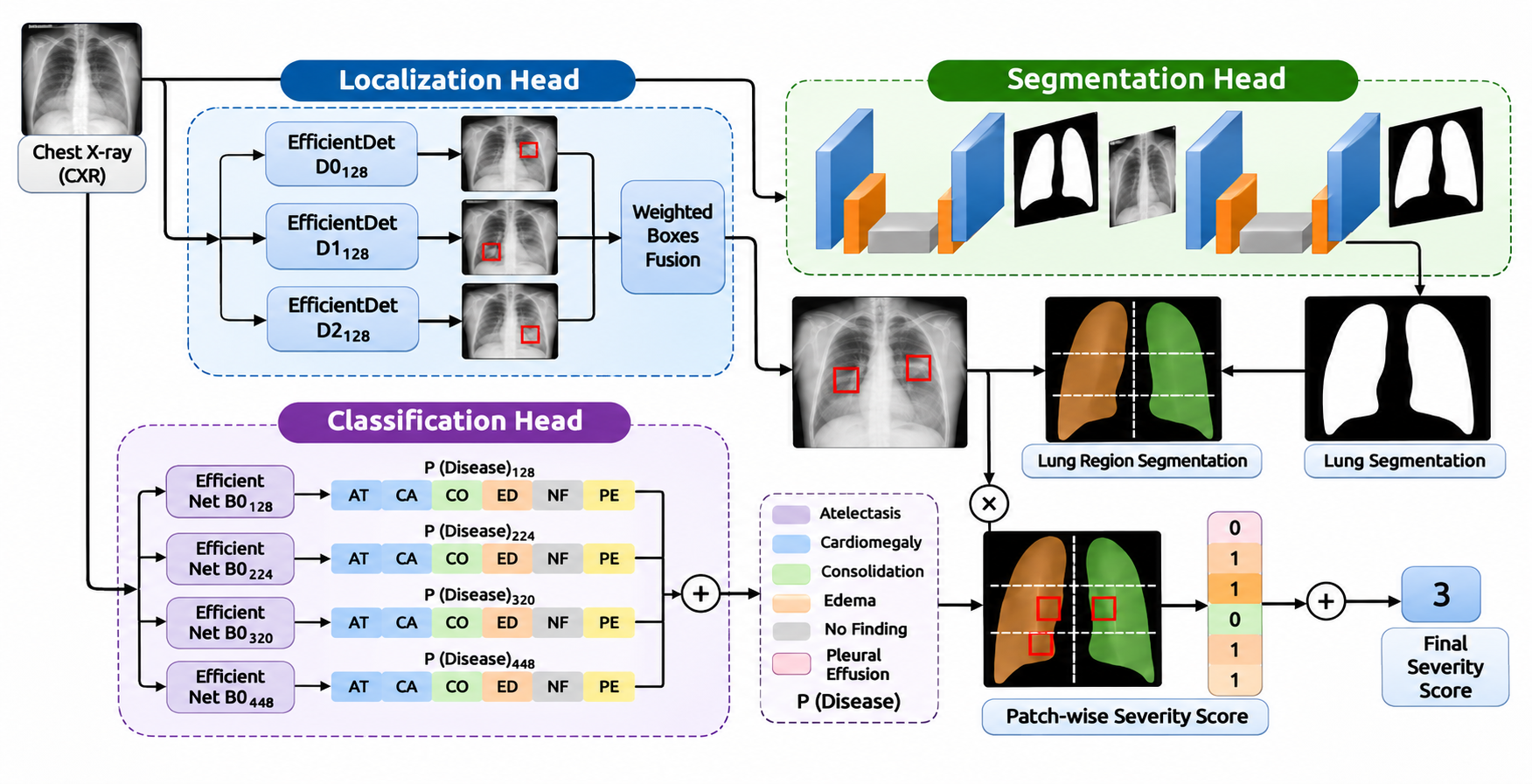
The proposed framework integrates three deep learning components: an EfficientNet-B0 ensemble for classifying six pulmonary conditions, a lightweight Little W-Net for lung segmentation, and an EfficientDet ensemble for localizing pulmonary opacities. The study further introduces a modified progressive learning strategy in which classification models are trained using progressively increasing image resolutions while maintaining controlled augmentation levels. Detected opacities are mapped to six anatomical lung regions to estimate disease severity on a scale of 0–6 for atelectasis, consolidation, edema, and pleural effusion. The framework was evaluated using the BRAX dataset, achieving an average AUROC of 0.88 for disease classification, an F1 score of 0.9246 for lung segmentation (improving to 0.9398 after fine-tuning), and an 80.8% mean matching score for severity assessment. This work demonstrates the potential of integrated deep learning approaches for automated pulmonary disease analysis and severity scoring from chest X-ray images.