
Deep Learning Based Osteoporosis Detection from Knee X-ray Images Using Knowledge Distillation and Incremental Learning
- Status
- Current
- Research area
- Radiology
On this page
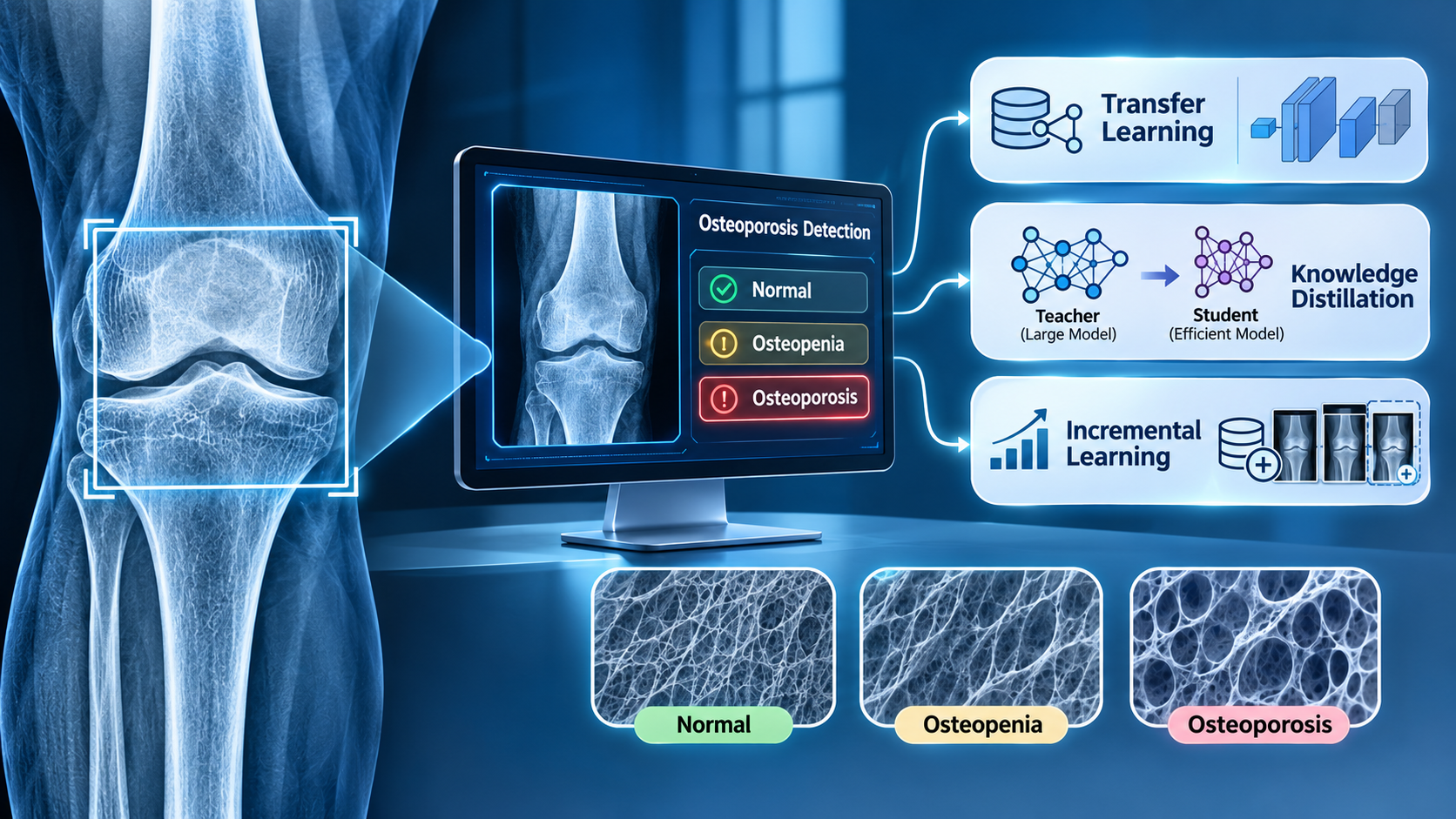
Osteoporosis is a progressive skeletal disorder associated with reduced bone density and deterioration of bone structure, increasing the likelihood of fractures and other skeletal complications. Medical imaging provides an important means of examining bone structure and identifying imaging patterns associated with changes in bone health. Deep learning techniques offer opportunities for automated analysis of radiographic images by learning discriminative features directly from medical imaging data, potentially supporting more consistent and efficient osteoporosis classification. However, developing practical deep learning solutions for healthcare applications involves several challenges, particularly the computational requirements of complex models and their ability to generalize across different datasets. Another important challenge arises when models need to learn from newly available data or previously unseen classes. Conventional training approaches often require retraining the entire model, while sequential learning can result in catastrophic forgetting, where previously acquired knowledge is lost as new information is introduced. Addressing these challenges is important for developing adaptable and computationally efficient AI-based systems for medical image analysis.
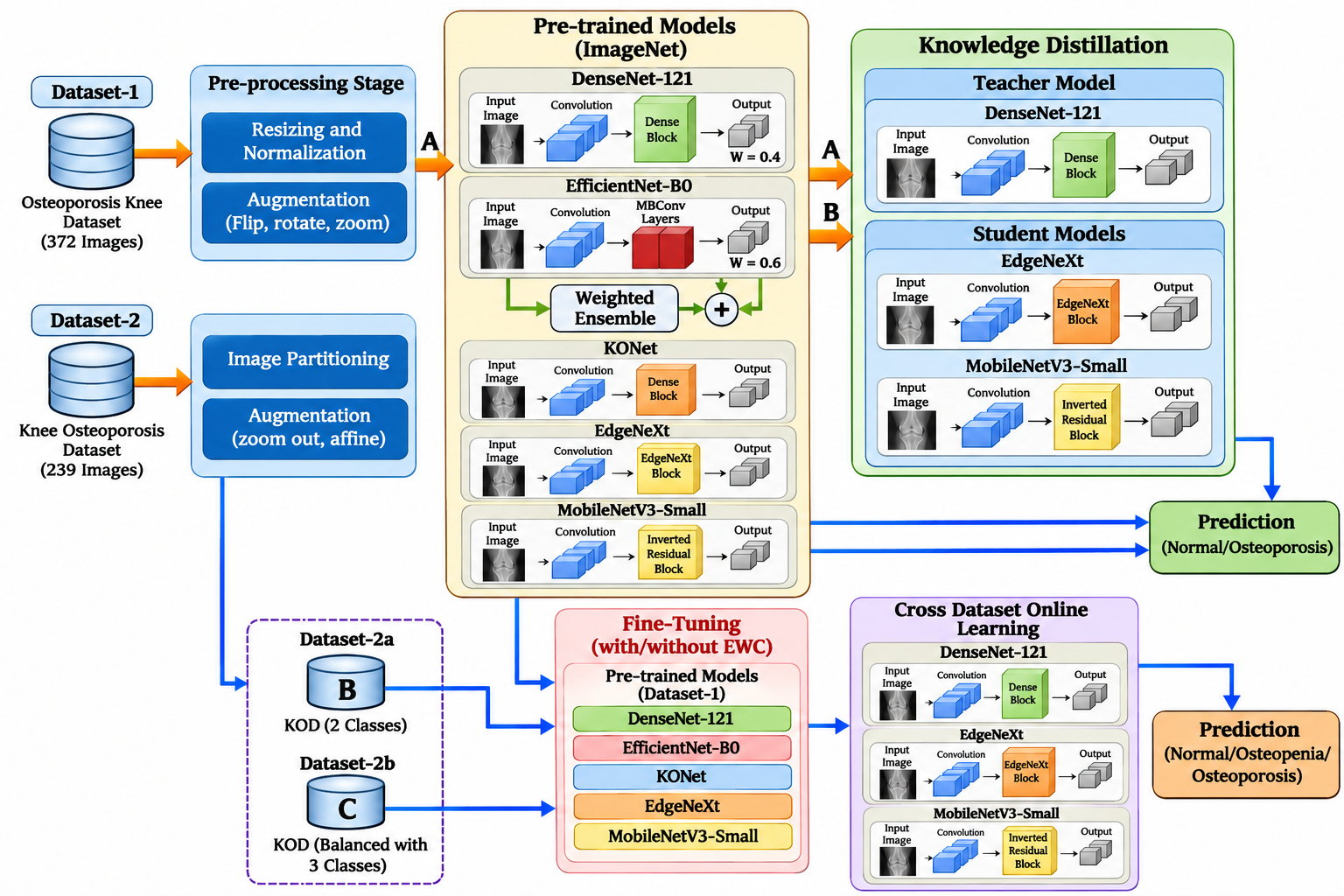
This research investigates automated detection and classification of osteoporosis severity using two publicly available knee X-ray datasets containing normal, osteopenia, and osteoporosis cases. Multiple deep learning architectures, including DenseNet-121, EfficientNet-B0, EdgeNeXt-Small, and MobileNetV3-Small, are evaluated using transfer learning to identify effective approaches for extracting discriminative imaging features and classifying different bone health conditions. Beyond conventional classification, the research explores knowledge distillation to transfer learned information from larger teacher networks to smaller student models, with the aim of reducing computational complexity while maintaining classification performance. Furthermore, incremental learning strategies are investigated to enable models to incorporate new datasets and previously unseen classes without requiring complete retraining. Elastic Weight Consolidation (EWC) and Learning without Forgetting (LwF) are employed to reduce catastrophic forgetting and preserve previously learned representations during successive learning stages. The overall objective is to develop efficient, scalable, and adaptable deep learning models for automated osteoporosis detection from knee X-ray images, with potential applications in resource-constrained healthcare environments.
Relevant Publications
- Maryum, Alina, Haider Azam, Arslan Shaukat, Norah Saleh Alghamdi, Muhammad Usman Akram, Ayesha Haque, and Anum Abdul Salam. "Utilizing knowledge distillation and incremental learning for osteoporosis detection on knee X-ray images." Scientific Reports (2026).