
AI-Driven Spinal Vertebrae Localization and Scoliosis Classification Using Transformers
- Status
- Completed
- Research area
- Radiology
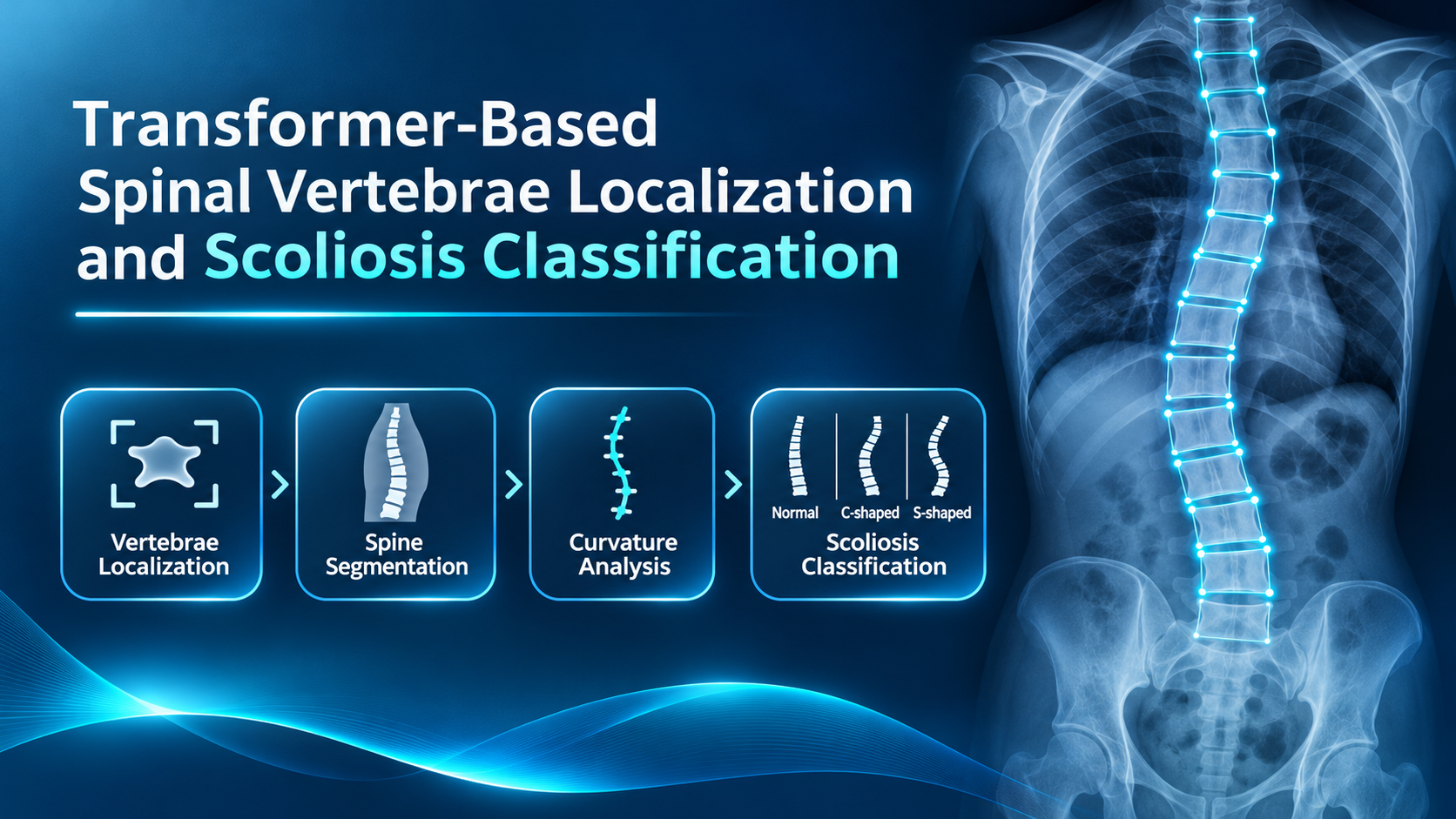
Accurate assessment of spinal alignment and curvature is essential for the diagnosis and evaluation of scoliosis and other spinal deformities. Anterior-posterior spinal X-rays provide important anatomical information for identifying vertebral positions, evaluating spinal alignment, and measuring curvature-related characteristics such as the Cobb angle. However, manually identifying vertebral landmarks and assessing spinal curvature can be time-consuming and challenging due to variations in vertebral morphology, image quality, and the severity and pattern of spinal deformities. Existing automated approaches often address vertebral localization, spine segmentation, and curvature classification as separate tasks, limiting their ability to provide a comprehensive assessment of spinal morphology. This research explores an integrated artificial intelligence framework that combines transformer-based localization, anatomical segmentation, and machine learning to automate spinal analysis and distinguish between clinically relevant curvature patterns.
The proposed framework consists of four stages for automated vertebral localization and scoliosis classification. First, a Detection Transformer (DETR) with a ResNet50 backbone identifies 68 corner points corresponding to 17 vertebrae in spinal X-ray images. Second, SegFormer performs spine segmentation to extract the spinal region. Third, vertebral centroids are calculated and combined with morphological thinning to generate a central spinal profile representing the overall curvature. Finally, five handcrafted features describing global and segment-wise curvature characteristics are extracted and supplied to machine learning classifiers to categorize spinal morphology into three classes: normal, C-shaped, and S-shaped. Evaluated on 609 anterior-posterior X-ray images from the AASCE MICCAI 2019 dataset, the framework achieved an mAP of 0.96 for vertebral localization at IoU 0.5, a Dice score of 0.93 for spine segmentation, and a classification accuracy of 98.3% using Random Forest. This work demonstrates the potential of combining transformer-based localization, segmentation, and curvature-based feature analysis for automated spinal deformity assessment.
